Nmesh – Drug Full of Remixes (#22 – 31)
Drug Full of Remixes (#22 – 31)
Nmesh
Compilation
Experimental
Liam Murphy
January 22, 2020


In 2025, New York’s Lia Ouyang Rusli, known as OHYUNG, released You Are Always On My Mind, her profound ode to the rave. It honours the club’s tense, hazy rooms and their tendency to support self-actualisation – Rusli’s own in propelling her transition, and others’ in critically viewing the precarious dancefloor as a vital site for soul-searching. While it lasered in on Bushwick and surrounds, Rusli’s meditations on harnessing her truth as guided by string-laden techno – that breadth indebted to her trade as a film composer – can be extended to anyone utilising raving as practice, letting the beats direct them to new temporal possibilities.
Yet what happens when that utopian space, home to non-uniform bodies, has cleared of its activity for the night – or early morning? The lights and speakers are powered off, the spillage of sweat and alcohol remains, and the ravers return to their mundane routines. The empty dancefloor thrums with the lack of their collective presence; it waits for the next cohort of dancers to create their brief escape from the burdening expectations of the daytime – and nurture their history. Being transgender herself, Rusli understands that when separated from that liberating space and forced back into the real, holding on to that identity protected by the lights and music becomes more important than ever.
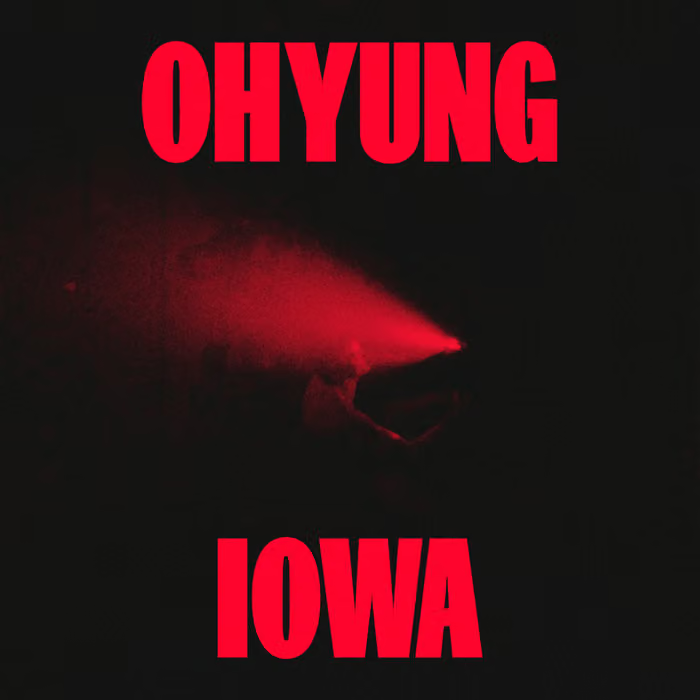
Created in tandem with You Are Always On My Mind, IOWA – a queered and starker Bruce Springsteen’s Nebraska – is a remarkable evocation of Rusli’s time living in the state, an astonishing release for a couple of reasons: Its stormy, mournful ambience seems far removed from the comparatively accessible hedonism of her previous album; and it depicts the embracing of the state’s pastoral, agricultural beauty with a concurrent resistance to its underlying right-wing fascism.
But the two records inform each other: This is the unease after the rave, the attempt to seek like-minded community in the state’s daylight – in which we are paradoxically rendered less able to see than in the dark of the dance – which has legislatively devastated transgender rights, but Rusli’s visceral, autobiographical ambient excursions are evidence of true hope.
A combination of the titles affixing her experiences with peers in Iowa – read kiara, all dolls go to heaven, and the black angel – and the simulated tape hiss distorting Christian pastoral hymns display a reclamation of the destructive imposition towards her people. The rupture in the vast ambience is the fine line between terror and empowerment. all dolls go to heaven flutters with divine voices, the rave’s dolls are reified for their existence, undeserving of prosecution.
But sharp, surging winds interrupt the elongated hymn, an adversarial environment penetrating a safe space. The swelling gusts of january epitomise the gelid bleakness of Iowa at the year’s beginning, its shivering desolation hitting like wind chills – no dancers are visible in the freeze.
Iridescent synths chatter on dancing parakeets, mimicking the birds Rusli brought with her from Bushwick. Her pets’ enchanting chirps are pushed through melodious scales, a memento of the familiar, uplifting kaleidoscopic raves of New York’s underground – but recognising the distance from that safer city makes these buoyant bird calls feel disquieting and isolated.
The howling tornado sirens on storm chaser feel more so, situating the listener right in the heartland, victim to its harsh atmosphere. They witness the cataclysmic destruction from afar, and feel further unnerved as the landscape, becoming sapped of its green-and-gold glow, recalls the worsening political surroundings for trans people as well as immigrants, the former just a few months ago having local level protections snatched away from them by their governor, Kim Reynolds.
Then, the pummelling explosions concluding christofascism mark the moment those unfairly hurt by despotism take a stand – the percussive flickers resemble invasive, scanning state forces, the mangled choirs are the “deliverance” they deal out, but those encroached still do not succumb to this agitation. They resist by continuing to exist, holding onto a modicum of optimism captured on the dancefloor.
That optimism shouldn’t be a necessity to survive; it should be a given. That comes through community, however. The 12-minute commemorative memorial is in memory of Chris Wiersema, a beloved figure in Iowa’s music scene. It aches beautifully as the bond between the two composers, and the many other Iowans Rusli met during her stay, finding community at their raves.
From the club into the cold world, IOWA beholds stories of life and loss, and societal oppression, immediate notions different from You Are Always On My Mind’s epiphanous harmony, but all are ultimately tangible across both. It comes back to the dancefloor – that haven to contest dominant narratives, which segregate through vitriolic policy and social tension, is an elixir for survival, be it crowded or empty. Ultimately, through her work as OHYUNG, Rusli exhibits the transformative possibilities unlocked from the intersection of music and environment, even when those entities are radically disparate.