
VOICE ACTOR – Sent from my Telephone
Sent from my Telephone
VOICE ACTOR
Album
Alternative
Liam Murphy
November 4, 2022


May 28, 2026
Tracks in this feature
Tracks in this release
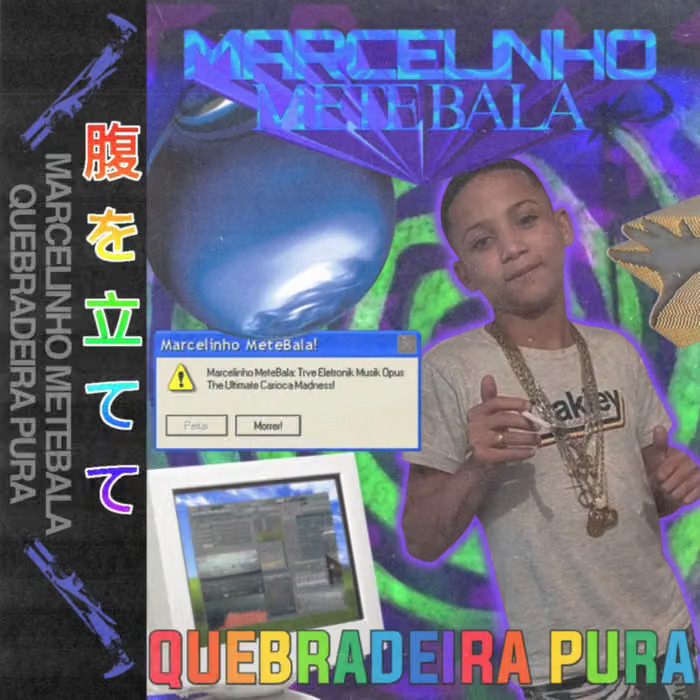
Stepping into the world of Brazil’s anonymous producer is like discovering a secret room in Habbo Hotel, a lobby where chronically online users gather – people whose entire relationship with music, community, and collective experience has been mediated by a screen for so long that the in-person stimulus of raves packed with light shows, artificial fog, DJs spinning out of their minds, or drugs that chemically induce a sense of temporary communion holds no particular appeal. They don’t need that otherworldly experience that regulars past and present find some meaning in – some as an act of resistance, others as escapism, depending on the flavour you choose – in spaces where the pounding bass produces a physical enchantment that no screen could ever replicate. Though Quebraidera Pura might make you wonder which direction envy runs.
Marcelinho MeteBala captures in full throttle this pandemic, SoundCloud-esque zeitgeist (gimmicks included) through frenetic techno tracks steeped in the murkiness of tanzelcore, a microgenre of dungeon synth that grafts dancefloor elements onto an already lightless atmosphere rooted, as we know, in black metal. The Brazilian borrows freely and transforms his sources into an experience of mashups, hardcore breaks, funk carioca and gabber that pulverises every last trace of stiffness that tanzelcore can carry. The rapid-consumption blend of mashups goes head to head with the musical interests MeteBala – whoever that is – seeks to satisfy: an eclecticism whose only coherence is the appetite itself.
But Quebraidera Pura holds a paradox: the very same record that works as a soundtrack for a late-night session in front of a screen can crash a DJ set without losing a gram of its strangeness. Nova Holanda establishes this from the jump: plastic keyboard techno held together by an arpeggiated bassline whose dark tonalities nod to tanzelcore without committing to its slower, dungeon-paced rhythms. Metebala borrows the atmosphere but runs it at a different speed. Vai amor pushes it further: its main melody sounds like keygen music, that functional, chiptuned accompaniment to software piracy that nobody composed to be listened to and everyone heard anyway. The coherence of all this is not accidental: it follows the same logic as Habbo Hotel, Runescape, Second Life, virtual social worlds where people organised online parties in pixelated lobbies, occupying digital spaces as a substitute for physical ones, long before the pandemic made that a necessity.
Mochila Nas Costa/Death by Gazamour is where MeteBala pushes the eclecticism to its boiling point. The funk carioca base samples the Papyrus theme from Undertale: a melody that long ago escaped the game it came from and took on a life of its own through YouTube videos, Facebook reposts, and whatever platform happened to be running the meme cycle at the time. There are people who have never played Undertale but would recognise that theme instantly, absorbed through years of digital osmosis. From there, the track accumulates layers: bubbling rhythms, melodies pulled from who knows where, a Counter-Strike sniper shot sound effect, the sound of blades being sharpened that points directly to the world of Chuquimamani-Condori. It’s a track that could collapse under its own weight and yet holds together, perhaps because MeteBala doesn’t rank his sources: the Undertale sample is worth exactly as much as the CS sound effect, and that democratisation of material is part of the proposition. The closing statement comes from Sequencia Taradona, the collaboration with the Brazilian dungeon synth artist Morkesis and the longest track on the record at only four minutes. It begins in eurodance, a style that never really died, just migrated online, and ends somewhere near trance, a sequence that takes its time mutating and functions as the moment where Quebraidera Pura takes a deep breath before it ends. With Morkesis on board, tanzelcore stops being a reference and becomes a presence inhabiting it for a moment.
Trem Bala/Olhei Gostei closes the record with an Imogen Heap loop that points directly back to Clams Casino’s I’m God: that 2011 beat immortalised by Lil B that gave internet cloud rap the initial kick it needed. It sounds like stumbling across someone’s randomly saved files on an old hard drive as music that wasn’t meant to be found, that gains something precisely because it was. This isn’t merely an act of nostalgia, but rather a clear connection to the sonic source. MeteBala knows where the reference comes from and states it unapologetically in the final track.
Quebraidera Pura works just as well soundtracking a late-night gaming session as it does closing a DJ set at 4am; the same record, two completely different rooms. That ambivalence is not a production accident but the enabling condition of the record: the aestheticisation of internet culture produces something that moves with equal ease in the solitude of headphones and the physicality of the dancefloor; the samples, tanzelcore as a genre native to the web, the weirdcore aesthetic of the early part of this decade all point in the same direction. Marcelinho MeteBala, whoever that may be, proves to be a producer as omnivorous as they are compelled to blend: they don’t choose between their influences, they pulverise them together until the mixture sounds inevitable.


.png)


.webp)


.webp)


.jpg)