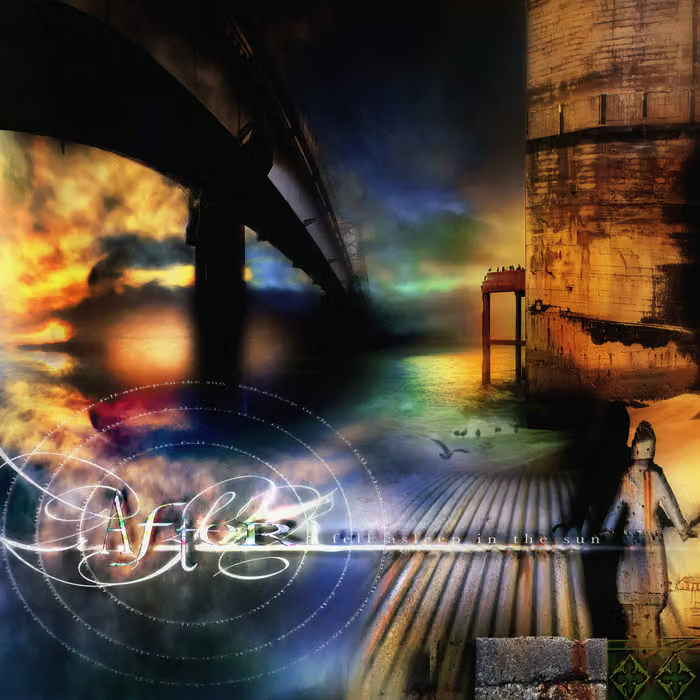
After – Fell Asleep in the Sun
Fell Asleep in the Sun
After
Album
Alternative
Liam Murphy
October 4, 2026


.jpg)


Not long after the big top of Perfect Brand Experiences appears, dubstep bass sets the air ablaze, its jagged waves like the instantly gripping web of a Flock camera network. The jungle snares appear like people seen only as pinprick datapoints by technological surveillance systems.
After that, foreboding bells descend deep into the big top, as recognisable clowncore dances us through a hall of mirrors.
The listener is dragged through two reflective surfaces a mere minute into Nero’s Day at Disneyland’s (NDAD) Grand Reopening: that of a “stiflingly surveilled” country, and the equally ludicrous world of the fairground.
Both warp us into crude, misshapen versions of ourselves: one for our own amusement, the other, for the state’s and private interests. These days, Lauren Bousfield is struggling to tell the difference between the two.
The Grand Reopening is 17 years in the making. It has been more than a decade and a half since the nightmarish floats and swarms of squeaking mouseketeers of From Rotting Fantasylands came to a halt, left in a state of perennial combustion; synth phrases and jolly circus snippets fitting into smoggy breakcore phrases way back at the start of the 2010s. A millennium in the world of electronic music.
From here, the driver of NDAD climbed out of the mech and was human for a while, releasing a number of albums under her own name.
This Grand Reopening comes due to an impasse.
“I didn’t want to express myself as a person anymore,” Lauren tells me over Zoom. In a world perceived effortlessly and instantaneously by weightless agents and networks before human perception has even got its boots on, it’s an understandable feeling.
“In NDAD, there is no Lauren. I’m an operator working the levers of a machine.” It is a vehicle through which she can build a world free from grimy human touches. There is, as she says, no personal polemics, like that of 2024’s Salesforce. “I would sing about something serious, then sing about something jokey and mix the two,” she tells me.
On Grand Reopening, she has no voice. People are “just numbers” to be captured and processed. Words so often fail, a fact that Lauren knows through long periods of silence as a child, and reiterated by a second appearance of her country’s bloated ringmaster. The hopscotch of silly to serious is also absent on this release: “It’s all one big dark joke.”
In NDAD, there is no Lauren. I’m an operator working the levers of a machine
But there are voices caught up in the machinations of NDAD’s brand new system. They are not Lauren’s own, but are indicative of how the project has been remade for our modern era. On Ghost Debt, a pitched-up operatic voice winds through the twisted metal of percussion. “Look at me…” a voice repeats, before launching into a theatrical melody. It is the lurid call of the attention economy extracting capital from the movements of our eyes.
Choral voices can be seen through the jagged shrapnel at points too – as well as ghostly apparitions on the closing track – the human elements demoted to mere spectators (and even spectres) in a story increasingly told by machines.
It’s perhaps not surprising that Lauren tells me of a surprising source of inspiration to her work: the works of Charles Dickens. She holds a copy of Bleak House aloft. “His stories talk about intensely fucked social circumstances in ways that can make you laugh.”
A resident of the “great city”, that was all too aware of the intensity at which such modes of living could alienate and extract from people. A man that wrote of even the rays of sun as “bars of the prison of this lower world”.
London, as Engels wrote, was a city of “unfeeling isolation” that reduced “mankind into monads”.
“NDAD and this album are about alienation.”
From Rotting Fantasylands huffs and wheezes with a kind of sooty Dickensian drive, the industrial cloaked in the carnival garb of America, a puttering parade float carrying leviathan cartoon characters through the street. This Grand Reopening comes with an upgrade. The drive is similar, but now made slick and shiny for a cloud computing AI age.
This is reflected in the phases of floating breakcore, but also in the writhing style it takes. Quick to shift, adapting to conditions. If From Rotten Fantasylands was a Macy’s Day Parade explosion, then this represents similar street horrors being quickly flipped into a shitcoin and disseminated through countless bot social media accounts. NDAD’s form is adaptive, as is modern tech-infused capitalism.
On 2008 Financial Crash Theme Song, the original referent is missing entirely. A piano tune is played through MIDI keys, a facsimile of something real. But even that does not survive long before it is forced into hyperactive rapidity and jagged financial instruments skewer any sense of human value to it. Something almost real is transformed into a fast-moving vehicle of capital growth and supercharged for an accelerationist age.
As much as NDAD has had a firmware update for a modern age, Lauren’s own roots in music and transgressive styles are strong. In albums from the turn of the millennium, she appears as part of Beautiful Mutants and Strip Mall Seizures, contributing recognisable discordant keys to spiky geek punk and more artier excursions respectively. Undoubtedly, a lot of that disorganised excitement and anger has found its way into her later projects, honed first into the smoky electronic of early NDAD and now razor-sharp. It’s also found its way into the acerbic music she releases alongside Ada Rook under the title Door Eater.
Interestingly enough, when she’s not in the leviathan mech suit, Lauren Bousfield makes stock music. Wildly different from her own output, this kind of music is the guise that products or brands wear to pass as cultural objects, or films sometimes use for something that’s music-like.
“It’s not really music,” she tells me. “Or, it has a different function … But it’s important for artists to listen to bad music. I listen to bad music all the time, just to know what’s going on.” This welcoming of scope and persistence to enjoy music in all its forms finds its way into the interruptive state of NDAD’s new release, thundering pincer drums bursting into waiting rooms piped with circus-themed muzak. Marionette MIDI piano collapsing into chippy chaos. “I’m not a reliable narrator,” Lauren says, seeming to speak both on behalf of NDAD as well as herself, and this sudden return under that moniker.
This playfulness amid chaos is the dark joke. This Grand Reopening hits with such devastating impact, but with the agility and wit of a well-tuned circus act. It plays out as non-fungible tokenised demise. It targets us as an adversary and evaporates us through incisive percussion before bringing on the clown car. Here, the sadistic ringmaster is also the slapstick comedic relief. “I’m fine with getting silly with it,” says Lauren. “I’m happy to play the jester role.”
.png)
.png)

.avif)

.jpg)


.jpg)


.jpg)


.jpeg)


.webp)


